



Is AI-generated content bad for SEO? After spending years optimizing websites by hand and then reviewing what happens when AI content tools take over, my honest answer is: it depends on how much human review happens afterward.
In this post, I’m breaking down what I found when I compared a manually optimized article against one produced entirely by an AI content tool — same topic, same intent, very different results underneath the surface.
Key Takeaways About Is AI-generated Content Bad for SEO
- AI content tools are genuinely useful for speed, first drafts, and idea generation — but they aren’t SEO tools.
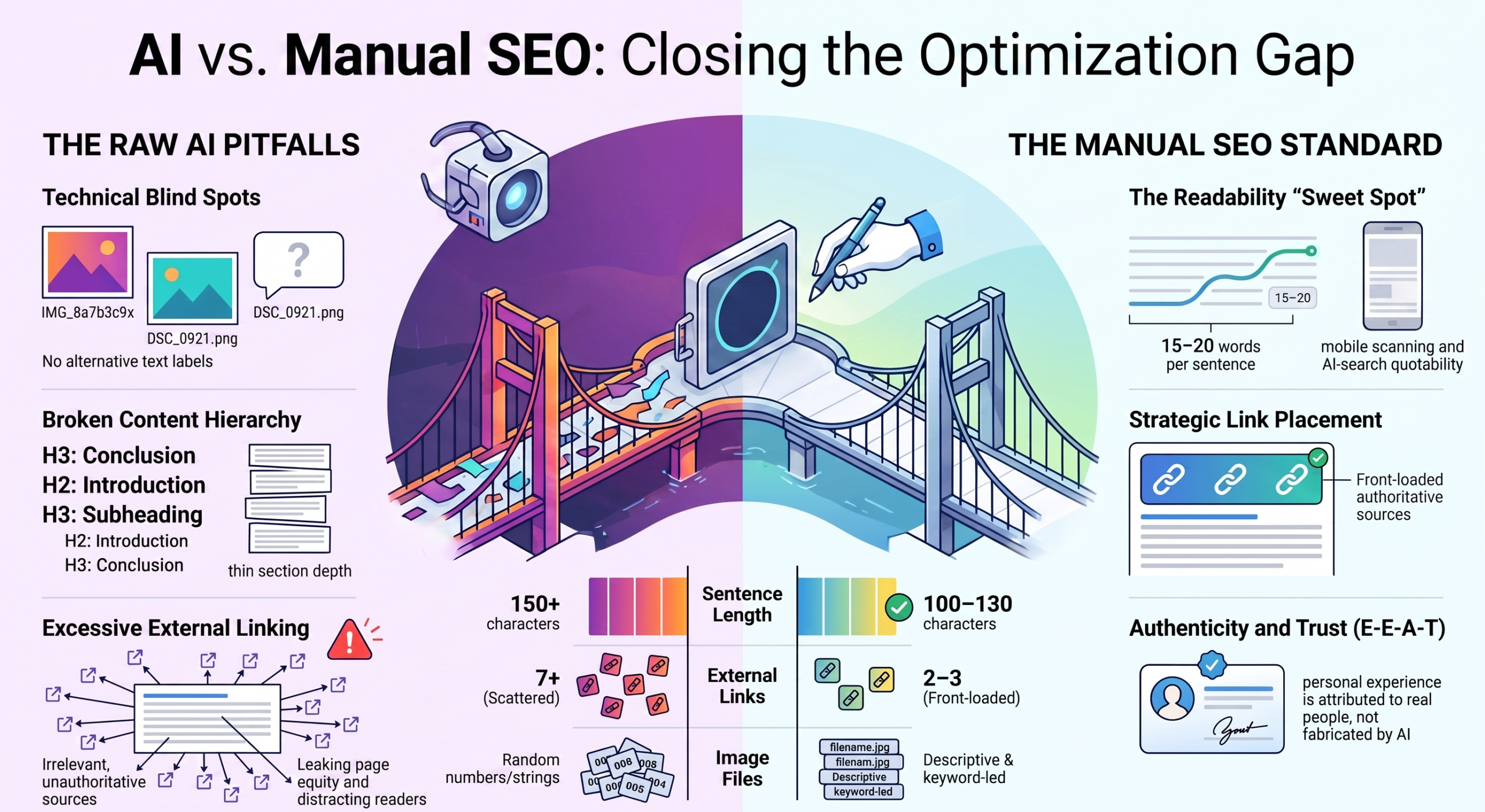
- The most common problems I see are unoptimized images, broken heading structure, excessive external linking, and overly long, wordy sentences.
- Best practice is to keep sentences to roughly 15–20 words (about 100–130 characters) for readability and scannability.
- A good rule of thumb for outbound links is to keep them to around 2–3 per post, placed early and pointing to genuinely relevant, authoritative sources.
- AI-generated content can rank, but almost always needs a manual SEO pass before it’s ready to publish.
My Background and Why I’m Writing This
I’ve worked in web design for six years and in SEO for four, and I have been helping small businesses get found online.
This comparison came out of a real situation: a client wanted to cut down on content costs and trialed a couple of AI content tools to produce blog posts instead of paying for manual writing and optimization.
On the surface, the posts looked finished. Once I actually opened them up and compared them against a manually optimized article on a similar topic, the gaps became obvious fast.
What “SEO-Ready” Content Actually Requires
Before getting into what went wrong, it’s worth being clear about what a properly optimized post needs, at minimum:
- A short, keyword-led URL slug
- Descriptive image filenames and unique alt text on every image
- A logical heading hierarchy, with one H1 and properly nested H2s and H3s
- Content with genuine depth, not just surface-level statements
- A sensible number of outbound links, pointing to relevant, trustworthy sources
- Writing that’s formatted and paced for scanning, not just reading top to bottom
AI content tools can technically produce something for every item on that list. In practice, most skip several of them entirely.
Pros of Using AI Content Tools
I don’t think it’s fair – or accurate – to say AI content tools have no place in a content strategy. There are two things they do genuinely well:
1. Speed and volume
An AI tool can produce a full draft in minutes, which is a real advantage if you’re trying to keep a consistent publishing schedule or need to test a lot of topics quickly.
2. A starting point for ideas
Even a flawed AI draft can surface subtopics, structure ideas, or a decent working outline that a human writer can then build on, rather than starting from a blank page.
That’s genuinely where the pros list ends for me, at least based on what I’ve seen in practice.
Cons of Using AI Content Tools (What I Actually Found)
1. Images uploaded with zero optimization
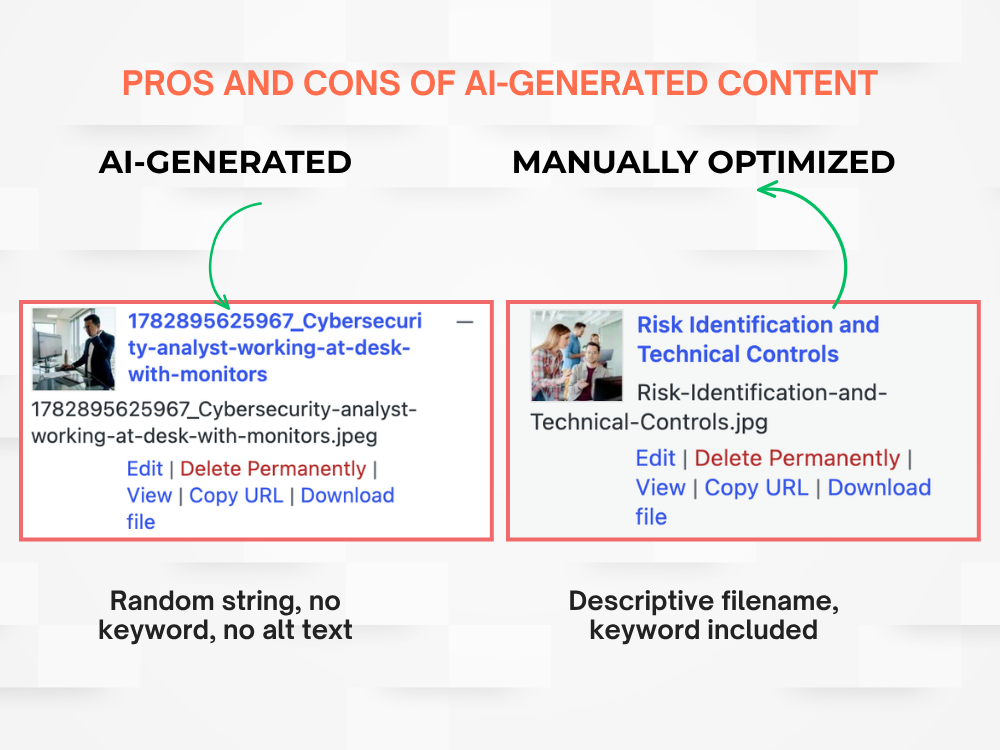
Every AI-generated image I reviewed had been uploaded exactly as exported — a random string of numbers for a filename, and no alt text added anywhere in the post.
Search engines can’t visually interpret an image; they rely on the filename and alt text to understand what it shows and to index it for image search.
Skipping this step means giving up on image search traffic completely, and it’s also a real accessibility gap for anyone using a screen reader.
What manual SEO does differently: rename every image with a descriptive, keyword-relevant filename before uploading, and write unique alt text that actually describes what’s in the image.
2. Broken heading structure and thin content underneath
The AI-generated article had heading levels that didn’t follow a logical order – H3s appearing before any H2 had been used, and headings that didn’t clearly map to the structure of the topic.
Underneath those headings, several sections were surprisingly thin: a heading would raise a question, and the paragraph beneath it would answer it in two or three generic sentences without going any deeper.
This matters because search engines use your heading structure to understand what a page is about and how the ideas inside it relate to one another.
A broken hierarchy makes that harder to parse, and thin content under a heading is a strong signal of low topical depth — both work against a page’s ability to rank or be pulled into a featured snippet.
What manual SEO does differently: map out the heading structure before writing, matching a natural hierarchy from the broad topic down to specific subpoints, and make sure each section fully answers the question its own heading raises.
3. Way too many external links
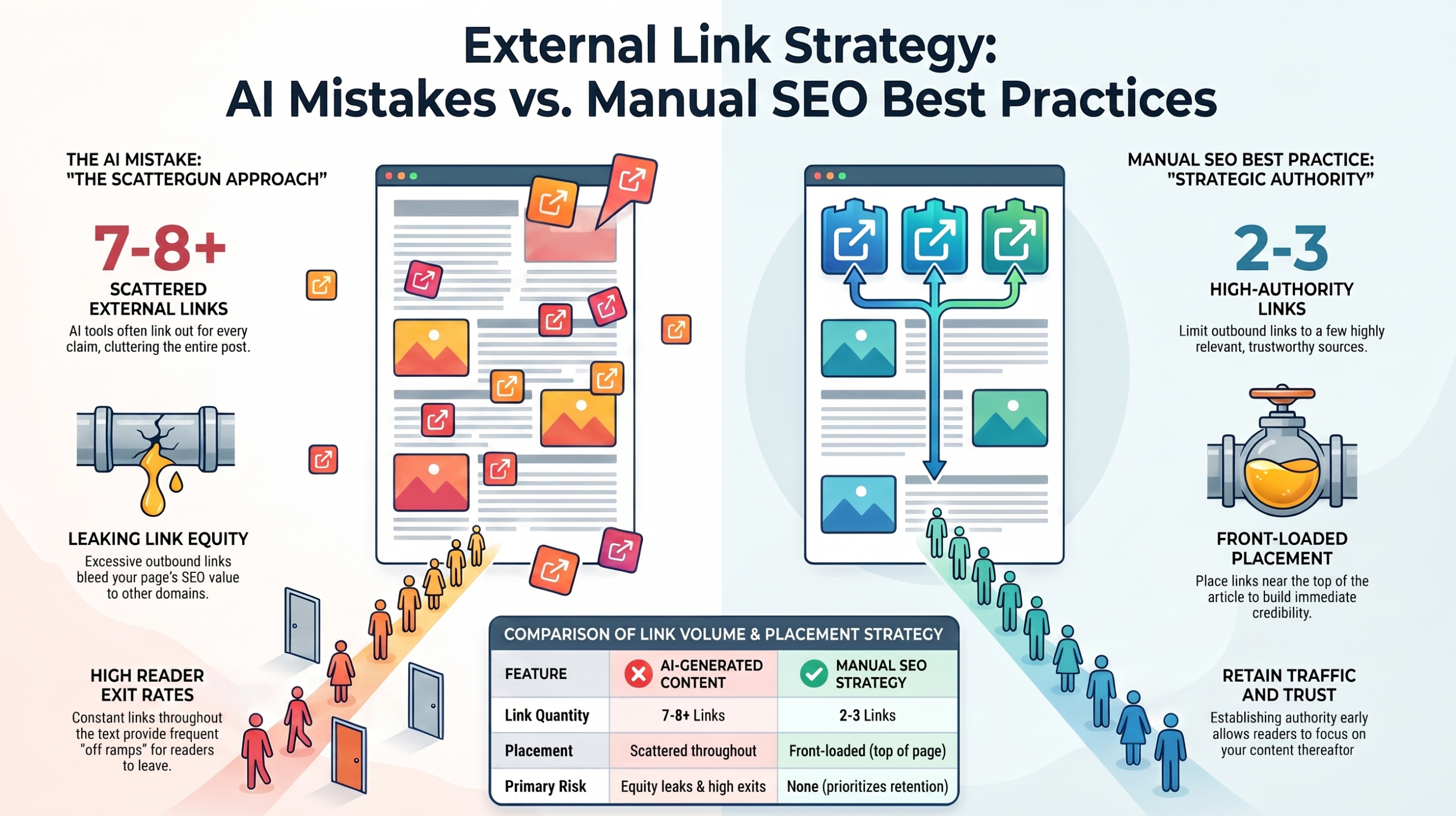
This was one of the clearest problems, and one I don’t see discussed enough. The AI-generated article linked out to seven or eight external sources, spread across the entire post.
Best practice is to keep outbound links closer to two or three per post, and to place them early rather than scattering them throughout.
Every outbound link is an opportunity for a reader to leave your site, and it also passes along a portion of your page’s link equity to another domain.
When AI tools cite a source for every claim, they’re leaking that equity constantly instead of using it strategically on a small number of genuinely valuable links.
What manual SEO does differently: choose two to three highly relevant, authoritative sources, place them near the top of the article where they add the most credibility, and resist the urge to link out every time a stat or claim appears.
4. Long, wordy sentences that are hard to scan
This is the AI writing pattern I notice most, across almost every tool I’ve tested, including tools marketed specifically for SEO.
Even SurferSEO’s auto-optimize feature, which is otherwise a strong tool, tends to produce sentences well over 120 characters when left on autopilot – long, comma-chained sentences that pack two or three ideas into one line instead of breaking them apart. (like this one!)
The best-practice range most readability tools flag as easy to scan is roughly 15–20 words, or about 100–130 characters, per sentence. That’s short enough to read comfortably on mobile and clean enough for an AI search engine to lift as a direct, quotable answer.
AI-generated drafts routinely blow past that range, which hurts both traditional readability and how easily the content gets pulled into AI-generated answers.
What manual SEO does differently: break dense sentences apart, lead with the main point, and check sentence length against that 15–20 word range during editing, not just leave the first draft as-is.
5. A voice that reads like it’s summarizing, not experiencing
The AI-generated article I reviewed included a section written in first person, styled as a personal opinion from someone at the company — despite the entire piece being AI-generated with no actual human input into that section. That’s a real trust problem.
Search engines increasingly reward content that demonstrates genuine first-hand experience, and fabricating a personal voice undermines exactly the kind of authenticity that’s supposed to build trust with readers and search engines alike.
What manual SEO does differently: only attribute personal opinions or experience to content that a real person actually wrote, and let AI-assisted sections stay factual rather than pretending to be a personal account.
Summary Comparison Table About Is AI-generated content bad for SEO
| Issue | AI-Generated Output | Manual SEO Approach | Impact |
|---|---|---|---|
| Image files | Random filenames, no alt text | Descriptive filenames + unique alt text | Image search traffic, accessibility |
| Heading structure | Skipped/duplicated levels, thin content | Logical hierarchy, developed sections | Crawlability, snippet eligibility |
| External links | 7+ links scattered throughout | 2–3 links, front-loaded, high authority | Link equity, reader retention |
| Sentence length | Often 150+ characters | 100–130 characters (15–20 words) | Readability, AI-search quotability |
| Voice/experience | Fabricated first-person sections | Real experience attributed to real people | Trust, E-E-A-T |
Is AI-Generated Content Bad for SEO?
Not inherently – but unedited, it usually underperforms against a properly optimized manual article on every technical measure that matters: image optimization, heading structure, link strategy, readability, and authentic voice.
AI content tools are fast, and that speed has real value. What they’re not yet able to replace is a human SEO pass that catches these issues before the content goes live.
If you’re using an AI tool to produce content, run every draft through a short checklist before publishing. Rename and tag your images, and check your heading order.
Count your outbound links and place them deliberately. Break up long sentences, and make sure any personal voice is attributed to someone who actually experienced it.
For a deeper look at how AI is reshaping search more broadly, it’s worth understanding the difference between traditional SEO and AI SEO, as well as what AEO actually means for how your content shows up in AI-generated answers.
If you’d rather not run that checklist manually every time, that’s exactly the kind of gap I help clients close. You can read more about my SEO services or get in touch if you’d like a second set of eyes on your content before it goes live.